

ACB tracking for accounting firms
One ACB across every broker and every year.
Wealth Write.Up is a full double-entry general ledger built for investments. It pools ACB across custodians, carries it forward, and produces capital gains and T1135 data at year-end.
Show me a client's ACB schedule See what it saves your firm
Double-entry general ledgerSOC 2 Type IIData stored in Canada27 yearsTaxprep and CaseWare
- Units held
- 2,150
- Total ACB
- $48,912
- ACB per unit
- $22.75
- ROC adjustments
- −$1,204
- Reinvested distributions
- +$2,316
- Carried forward to next year
- Ready
Why ACB is the hardest number in the file
Several brokers, one ACB
CRA treats identical securities as one pool. No broker statement shows the pooled ACB. Each one only sees its own account.
Every year builds on the last
Reinvested distributions and return of capital change ACB every year, and T3 slips arrive late. One missed adjustment carries into every later sale.
Every client, every entity
Holding companies, trusts and personal accounts each keep their own ACB. Dozens of clients means hundreds of schedules, usually in spreadsheets.
How it works
Upload statements from every custodian
PDF or scanned. The AI importer extracts the transactions and shows where each number came from. Every transaction lands in one register per account.
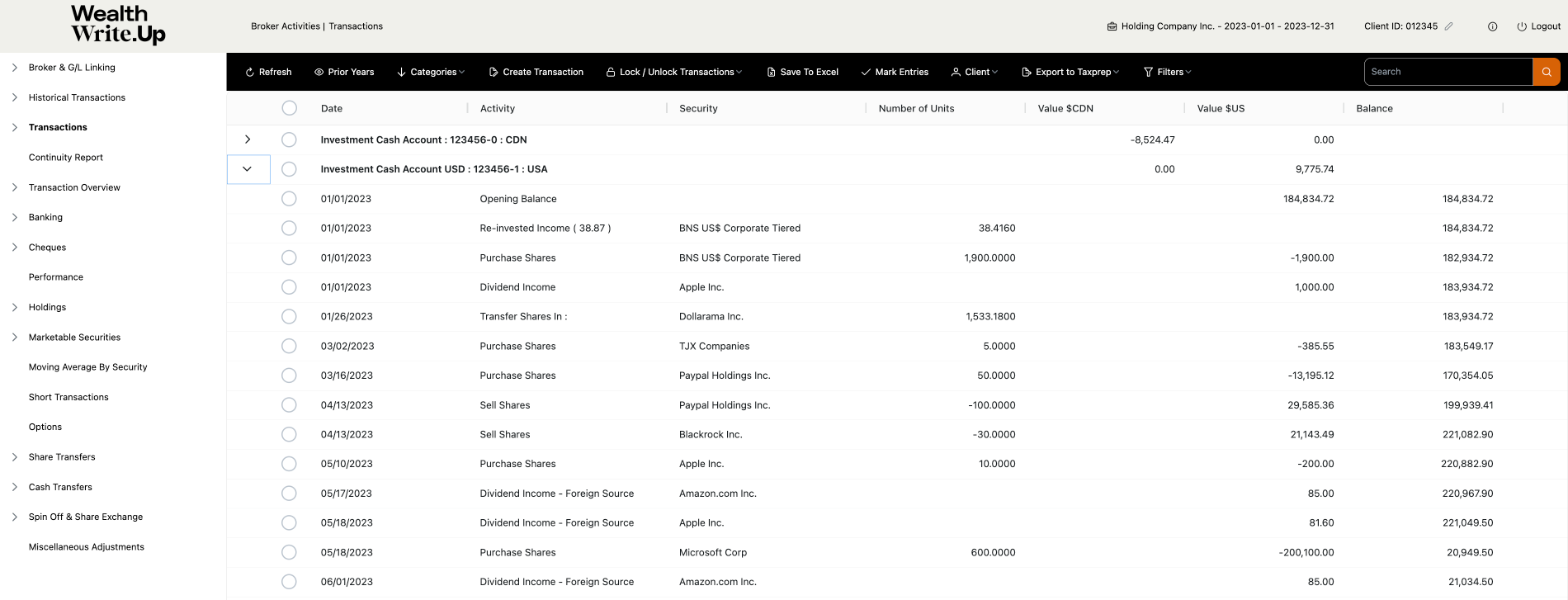
ACB is pooled and carried forward
The ledger pools identical securities across brokers and applies return of capital, reinvested distributions and splits. Every adjustment posts as a balanced journal entry, so total ACB agrees with the investment account on the balance sheet. Each year starts where the last ended.
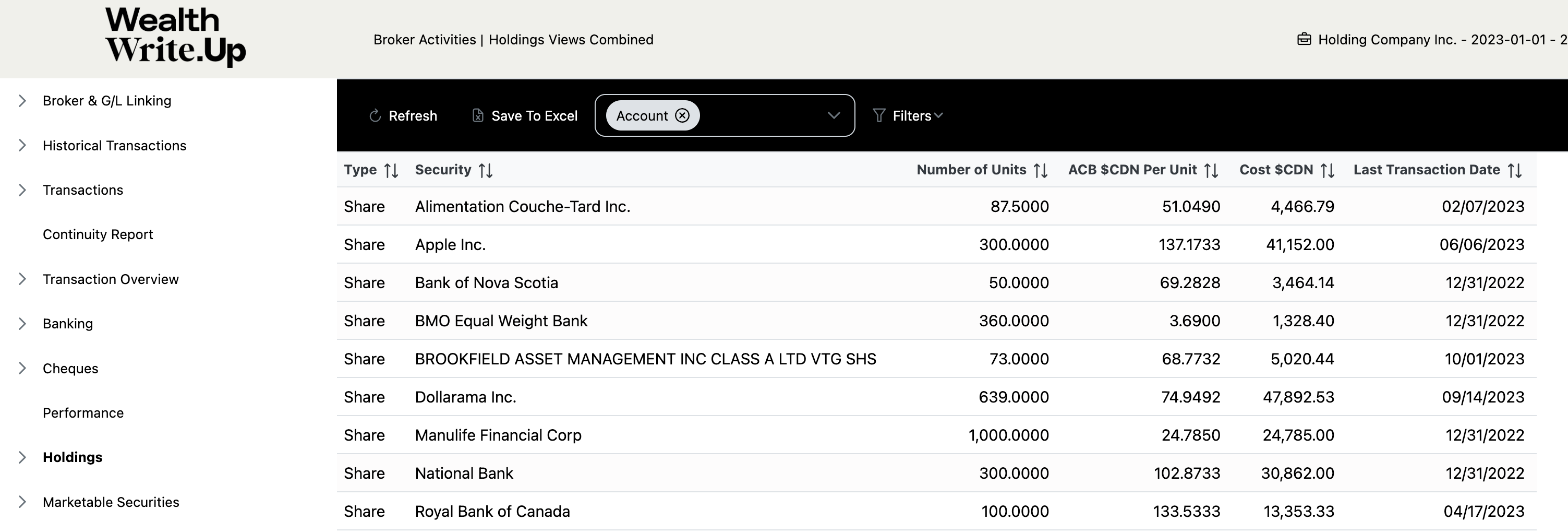
Close the year
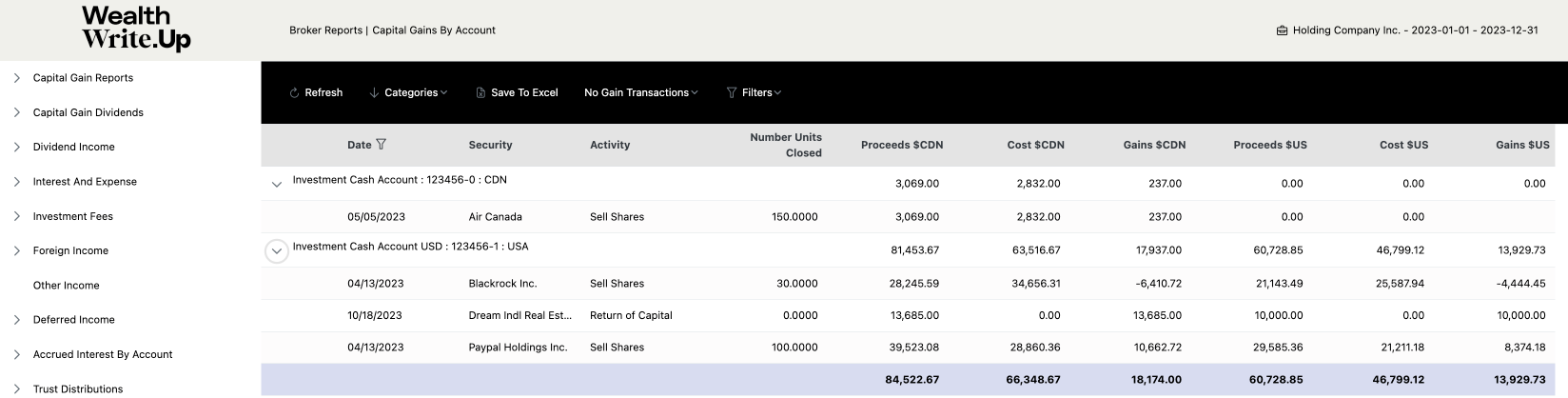
Capital gains, T3, T5 and T1135 data and 30+ reports in Canadian dollars at Bank of Canada rates. Return of capital beyond cost shows up as a gain. One-click Taxprep export.
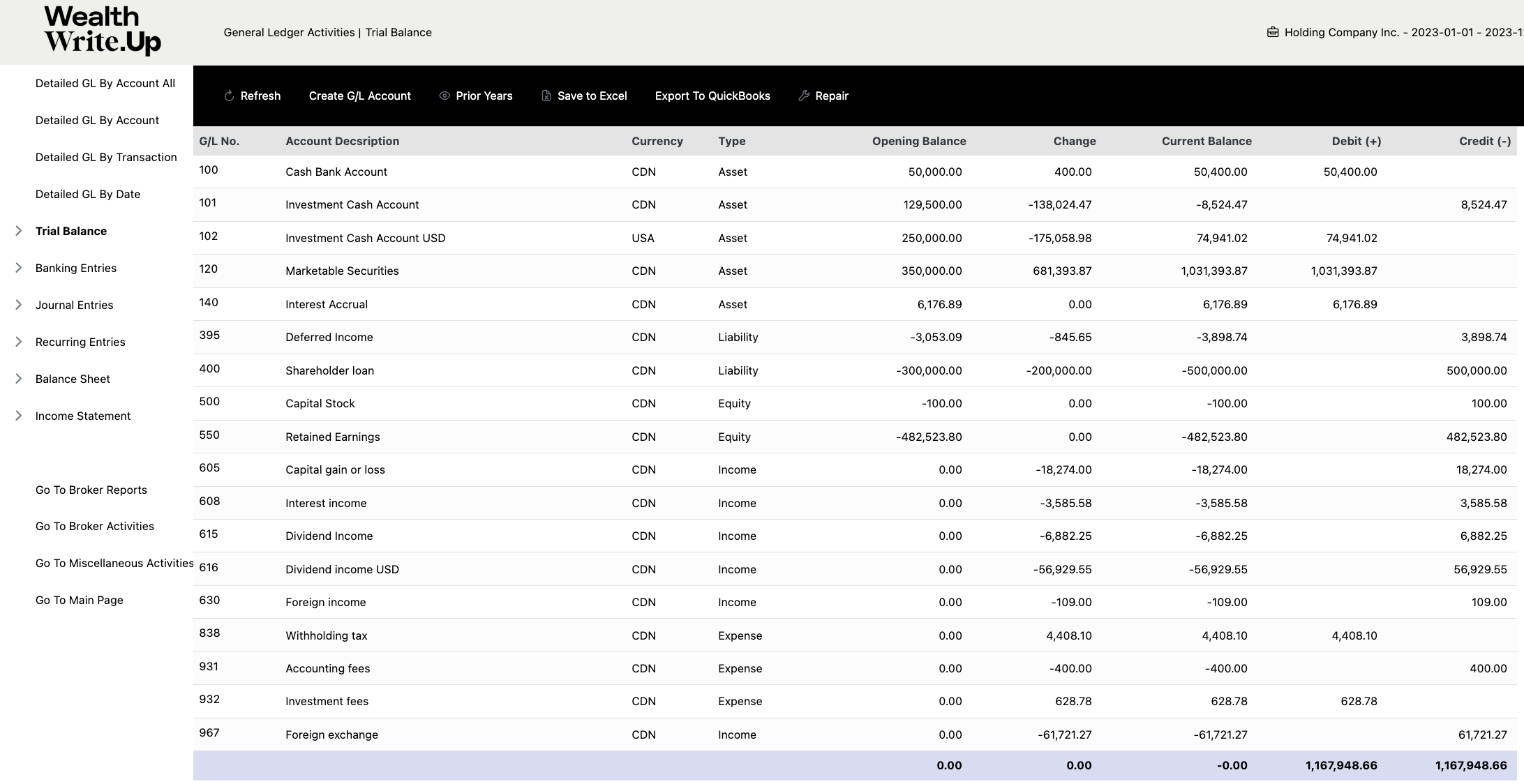
ACB that ties to the books
Spreadsheets and ACB calculators keep a list. Wealth Write.Up keeps books: a full double-entry general ledger with an investment subledger underneath it.
Balanced entries
Every transaction posts debits and credits that balance. Nothing changes ACB without an entry.
Ties to the balance sheet
Holdings at cost equal the investment account in the ledger, at every date.
Statements from the same entries
The trial balance, balance sheet and income statement come from the entries that drive ACB.
| Account | Debit | Credit |
|---|---|---|
| Investment cash account | 1,204.00 | |
| Investments at cost | 1,204.00 |
ACB for the position drops by $1,204, and the investment account on the balance sheet drops with it.
What it is worth to a 25-file firm
Close to 90 per cent of the value comes from work other than keying: reconciliation, year-end cost base, reports and look-ups.
Estimate for a 25-file firm working in Excel with two staff, conservative to expected. Your figures will differ.See how much manual investment bookkeeping is costing you
The return that is not in the number
Calmer audits
Every figure traces to a transaction in a full general ledger. Audit requests become a look-up.
Lower CRA penalty risk
Cost base, gains and foreign property are calculated, not hand-assembled. A missed T1135 can cost up to $2,500.
No key-person risk
The method lives in the system, not in one person's workbook.
Questions accountants ask
Is this a general ledger or a portfolio tracker?
A full double-entry general ledger with an investment subledger. Every transaction posts balanced debits and credits, and the trial balance, balance sheet and income statement come from the same entries.
Does it pool ACB across brokers?
Yes. Statements from every custodian go into one client file and ACB is calculated across the full position, as CRA requires for identical securities.
How are return of capital and reinvested distributions handled?
They adjust ACB when entered, and the adjusted cost base carries forward into every later year and disposition.
What about US-dollar holdings?
Foreign holdings are converted at Bank of Canada rates, so gains and T1135 data report in Canadian dollars.
Does it work with Taxprep and CaseWare?
Yes. One-click Taxprep export, and data moves in both directions with Taxprep and CaseWare.
Where is client data stored?
In Canada. Wealth Write.Up holds a SOC 2 Type II report, and uploaded statements are deleted after processing.
See one client's ACB, done.
Book 30 minutes. We run statements from several brokers into one ACB schedule, then show the capital gains and T1135 data it feeds. We reply within one business day.
For accounting firms and family offices. Managing your own portfolio? A free ACB calculator will serve you better.
A one-page sample ACB schedule: ACB pooled across three custodians, with return of capital and reinvested distributions applied. No call needed.
See Wealth Write.Up in Action
Whether you’re managing books for a family office, an accounting firm, or a holding company, we’ll tailor the demo to what matters most to your practice.